29 September 2010

Barbaric Acts


I pray for all the victims of that tragic day. Some of them are my close friends.

Stop this kind of senseless violence. Whoever knows the suspects who did this tragedy please turn him or them in. Let justice be served. For the perpetrators - even if you guys do not get caught, crime does not pay. You will have your day. Mamamatay din kayo, 'ina niyo.

***


44 hurt in Bar exams blast
Manila Bulletin

Manila Bulletin - Sunday, September 26

The last day of the Bar examinations at the De La Salle University (DLSU) on Taft Avenue, Manila literally ended with a loud bang yesterday after a late afternoon explosion that wounded at least 44 people, mostly students, police said.

The Manila Police District (MPD) identified 18 of the wounded, all students, taken to the Ospital ng Maynila (OsMa) and the Philippine General Hospital (PGH) but also said the total number of victims may go beyond 44. The OsMa admitted victims Joanna Katrina Ledda, Arvin Francis Rosales, Philip Edwin Teelo, Gennilyn Ong, Cyril Ferrer, Kathleen Samba, Azenith Gonzalvo, Jamell Ann Marie, and Renald Sudla. PGH records, as of 8:30 p.m., identified victims taken to the hospital as Raissa Laurel, Diana Espiritu, Claudine Abrogena, Datu Mohammad Abdul, Generson Mercado, Milanes Rainier, Eunice Abdon, Diane Camita, and Donelle Quilates. As of press time at 11 p.m. yesterday, the MPD continued to monitor more reports of victims of the blast since they had been admitted in separate hospitals - OsMa, PGH, Manila Doctors Hospital, and Manila Medical Center. MPD officer-in-charge Chief Supt. Roberto Rongavilla said it is not yet clear if the explosion, which occurred between 5 p.m. and 5:30 p.m. shortly after the Bar exams ended, was caused by either an improvised bomb or pyrotechnics. But witnesses on the scene claimed that it was an explosion and not just a ruckus that happened in front of the DLSU. ''We were not sure at first if it is an explosive or a drum that we heard at first. You can't tell the difference then because of the boisterous students from different universities. But the cheer suddenly turned into screams of panic,'' said a Bar examinee who was across the street from DLSU when the explosion happened.

27 September 2010

Better Than Bliss

Better Than Bliss was a song Joyce and I wrote circa 2005. It became our favorite composition to play whenever we get to be invited to perform. The song tries to describe how it feels to be in love, but eventually concedes that such feeling is indescribable -"... it's better than bliss... I don't know what it is..." then finally,  the immediate longing physical nearness - "boy i miss your kiss." The melody was meant to be soft but upbeat. This video was taken at Bella Bar in Greenhills almost a year ago. Bogs on the shaker, Bey (my childhood friend) on the classical guitar named "Sunshine", Rah on the yellow Yamaha guitar named "Mango", my brother Ryan on the beatbox, and Joyce on vocals.


Better Than Bliss
by Rah and Joyce Nobleza

I
My eyes are roamin' out the room to find
a special someone out there meant for me
as I gaze at your smilin' face, so real
no words can express the way I feel

Chorus
Can you know, that your touch
saves me from being lonely
can you hear, my heart
beating you're my one and only
it's better than bliss
I don't know what it is
it's better than bliss
boy I miss your kiss.

II
Days and nights are cold
when you're not with me
still I remain so faithful, can't you see
come caress my body longing for you
no one else can love me the way you do

Refrain
I know you're there 'so far 'need you to be here
there is no other place that I rather be...

Chorus
Can you know, that your touch
saves me from being lonely
can you hear, my heart
beating you're my one and only
it's better than bliss
I don't know what it is
it's better than bliss
boy I miss, boy I miss your kiss

 Refrain
You have a way of telling me I'm the one
And that goes the same for me
And that I can't deny...

Chorus
Can you know, that your touch
saves me from being lonely
can you hear my heart
beating you're my one and only
it's better than bliss
I don't know what it is
it's better than bliss
boy I miss your kiss

21 September 2010

The Death of Poker

In Facebook, they have a social game called ZyngaPoker. I have been playing it for quite some time now and I can say that I have became really good at it. I'm not bragging. There are probably guys out there who have more chips than me or has a higher rated level, but I can confidently say that I have reached a sort of semi-expertish level. In fact, from just one million chips last month, I now have 45Million chips.

I fell in love with the game of poker the first time I learned to play it. Perhaps, because the game is more like life itself -- the drama of life unfolds with every turn of a card.

Poker is a game of empathy. It is a game of understanding the intent and motives of your opponent so that  you can arrive at correct decisions.  Poker teaches a lot about life. It develops discipline, critical reasoning, management of finances, strategy building,  all are useful not only in life but also to almost any endeavor you want to pursue. In my quest for my first million, I have learned a lot of lessons from poker as in life, which I hope you can learn from, too:

Life is both luck and skill, in the short run, luck prevails, but in the long run skill  triumphs. Don't bluff, but don't be totally honest either. Be patient, composed, and calm. To get better, practice and study. Look for patterns. Never make an important decision when you're tired or have recently consumed alcoholic beverages. Stick to the level of stakes you are comfortable with and while you're at it, you might as well enjoy the game.

Since I have reached this far in "the game." I have no further intentions of pursuing another million chips. The game does not appeal to me anymore. I have done enough for the game, and for this, I am officially retiring. The game must end in one way or another and I must move on.

My skill in this game is a gift - that's true. But I also realized that if I must widen my horizon and find out what other talents I can cultivate - I must learn to let this go. As the saying goes, you can't discover new oceans unless you have the courage to lose sight of the shore.

11 September 2010

On Childhood Dreams

I love this video because it shows the power of childhood dreams. Like him, I am also blessed with parents who allowed me to discover my potentials as a kid.

They enrolled me into art classes (although I did not become a professional artist). They enrolled me to chess class (although I became really good at chess strategy and tactics, have yet to win my first medal). They enrolled me to music school to learn the basics of playing the guitar (although I've been to a lot of gigs and have composed a lot of songs, having an album at this point in time seems highly improbable).

But above it all, all these experiences did not come to waste. It shaped me to become who I am now
-- (a cute panda).

The guy in this video is correct. You can't lose either way. It is a win-win situation. "Experience is you get when you don't get what you want."
The highest reward for man's toil is not what he gets for it, but what he becomes by it. -  John Ruskin.

10 September 2010

What memory do you want to forget?

None, I want to remember everything.

Ask me anything

what is the purpose of your existence?

Wisdom is the purpose of my existence. I came here in this world to see, learn, and understand. Then, be understood.

Ask me anything

On Courage

“I learned that courage was not the absence of fear, but the triumph over it. The brave man is not he who does not feel afraid, but he who conquers that fear.” - Nelson Mandela


“Courage is not the absence of fear but the judgment that something else is more important than fear. The brave may not live forever but the cautious do not live at all. For now you are traveling the road between who you think you are and who you can be.”
-Meg Cabot

03 September 2010

On Problems

I woke up last Tuesday feeling down and tired. I felt that I was carrying the problems of the world. But I had no choice, I still went to class with full mastery and understanding of nothing. My head was empty as a coconut.

Alas it's time for class, but the good dean did not conduct his regular stomach churning recitations. Instead, he gave us a lesson on life. He advised us not to worry our life away. But what I loved the most on what he shared to us was his philosophy.
 "There are really no problems - only decisions to be made."
Since that Tuesday night, my understanding of problems has changed. I am no longer afraid of problems.

"When God closes a door, He opens a window. Did you notice that He solves the same problems he gives? You just have to return the problem to the person who gave it to you. Sometimes, you just got to have faith."
"There are really no problems in life, only decisions to be made."
I like it. I guess what brings light to a dark damp and clouded mind is worth repeating.

26 August 2010

Just Trying Again

Just trying to learn how to play the guitar again after a long while at my tita's 60'th birthday at Bellissimo, Tomas Morato. There was actually a duo band and miss lady in pink skirt was the vocalist. They asked the audience, "who wants to jam?!" -my tita (and the whole clan) volunteered me. I couldn't refuse. The repertoire -- Waiting in Vain,  Bob Marley.


25 August 2010

On Reading

No matter how busy you may think you are, you must find time for reading, or surrender yourself to self-chosen ignorance.
- Confucius
 
"You cannot remember what you did not read."

To read is to fly: it is to soar to a point of vantage which gives a view over wide terrains of history, human variety, ideas, shared experience and the fruits of many inquiries.
- A C Grayling, Financial Times (in a review of A History of Reading by Alberto Manguel)


A capacity and taste for reading gives access to whatever has already been discovered by others.
- Abraham Lincoln

To read a writer is for me not merely to get an idea of what he says, but to go off with him and travel in his company.
- Andre Gide

Reading a book is like re-writing it for yourself. You bring to a novel, anything you read, all your experience of the world. You bring your history and you read it in your own terms.
- Angela Carter

The reading of all good books is like conversation with the finest men of the past centuries.
- Descartes

 The more you read, the more things you will know. The more that you learn, the more places you'll go.
- Dr. Seuss, "I Can Read With My Eyes Shut!"

A book is the most effective weapon against intolerance and ignorance.
- Lyndon Baines Johnson

If you can read this, thank a teacher.
- Anonymous teacher


from http://www.readfaster.com/readingquotes.asp

23 August 2010

Bimby the Family Dog


“In order to keep a true perspective of one's importance, everyone should have a dog that will worship him and a cat that will ignore him.”

20 August 2010

On the Things We Do

" Almost anything you do will be insignificant, but it is very important that you do it. "

- gandhi

17 August 2010

Hide Your Wounded Finger

xxx
"145. Hide your wounded finger, or you will bump it on everything.
Never complain about it. Malice always zeroes in on what hurts or weakens us. Look discouraged and you will only encourage others to make fun of you. Evil intent is always looking for ways to get a rise out of you. It uses insinuation to discover where you hurt, and knows a thousand stratagems to probe your wounds. The wise will ignore malicious hints, and conceal his troubles, either personal or inherited, for even Fortune sometimes like to hit you where it hurts. It always goes straight for raw flesh. Be careful not to reveal what mortifies and what vivifies you, lest the former last and the latter end." (Gracian, 1647)
xxx

Annotation:
Hide your flaws and don't complain about it. Don't give evil intent the opportunity to draw satisfaction for your demise. Neither should you look discouraged -  for enemies will always look for ways to bring you down. Once they realize your weakness, the more they are encouraged to bury you deeper. The wise person is prudent, instead, hides his issues or troubles - may it be personal or inherited. He does not reveal his weakness nor give out his source of strength, because former stands time and what the latter is only good while it lasts.

Manual for Climbing Mountains by Paolo Coelho

Grabbed from Paolo Coelho's blog...

You can visit his blog here.

1 min reading: Manual for climbing mountains


Davos, 11 agosto 2010
________________

A] Choose the mountain you want to climb: don’t pay attention to what other people say, such as “that one’s more beautiful” or “this one’s easier”. You’ll be spending lots of energy and enthusiasm to reach your objective, so you’re the only one responsible and you should be sure of what you’re doing.

B] Know how to get close to it: mountains are often seen from far off – beautiful, interesting, full of challenges. But what happens when we try to draw closer? Roads run all around them, flowers grow between you and your objective, what seemed so clear on the map is tough in real life. So try all the paths and all the tracks until eventually one day you’re standing in front of the top that you yearn to reach.

C] Learn from someone who has already been up there:
no matter how unique you feel, there is always someone who has had the same dream before you and ended up leaving marks that can make your journey easier; places to hang the rope, trails, broken branches to make the walking easier. The climb is yours, so is the responsibility, but don’t forget that the experience of others can help a lot.

D] When seen up close, dangers are controllable
: when you begin to climb the mountain of your dreams, pay attention to the surroundings. There are cliffs, of course. There are almost imperceptible cracks in the mountain rock. There are stones so polished by storms that they have become as slippery as ice. But if you know where you are placing each footstep, you will notice the traps and how to get around them.

E] The landscape changes, so enjoy it:
of course, you have to have an objective in mind – to reach the top. But as you are going up, more things can be seen, and it’s no bother to stop now and again and enjoy the panorama around you. At every meter conquered, you can see a little further, so use this to discover things that you still had not noticed.

F] Respect your body: you can only climb a mountain if you give your body the attention it deserves. You have all the time that life grants you, as long as you walk without demanding what can’t be granted. If you go too fast you will grow tired and give up half way there. If you go too slow, night will fall and you will be lost. Enjoy the scenery, take delight in the cool spring water and the fruit that nature generously offers you, but keep on walking.

G] Respect your soul:
don’t keep repeating “I’m going to make it”. Your soul already knows that, what it needs is to use the long journey to be able to grow, stretch along the horizon, touch the sky. An obsession does not help you at all to reach your objective, and even ends up taking the pleasure out of the climb. But pay attention: also, don’t keep saying “it’s harder than I thought”, because that will make you lose your inner strength.

H] Be prepared to climb one kilometer more: the way up to the top of the mountain is always longer than you think. Don’t fool yourself, the moment will arrive when what seemed so near is still very far. But since you were prepared to go beyond, this is not really a problem.

I] Be happy when you reach the top
: cry, clap your hands, shout to the four winds that you did it, let the wind – the wind is always blowing up there – purify your mind, refresh your tired and sweaty feet, open your eyes, clean the dust from your heart. It feels so good, what was just a dream before, a distant vision, is now part of your life, you did it!

J] Make a promise: now that you have discovered a force that you were not even aware of, tell yourself that from now on you will use this force for the rest of your days. Preferably, also promise to discover another mountain, and set off on another adventure.

L] Tell your story: yes, tell your story! Give your example. Tell everyone that it’s possible, and other people will then have the courage to face their own mountains.

16 August 2010

Life Questions


grabbed from http://www.mischiefchampion.com/style/p/2010/Aug/life_questions

Surreal

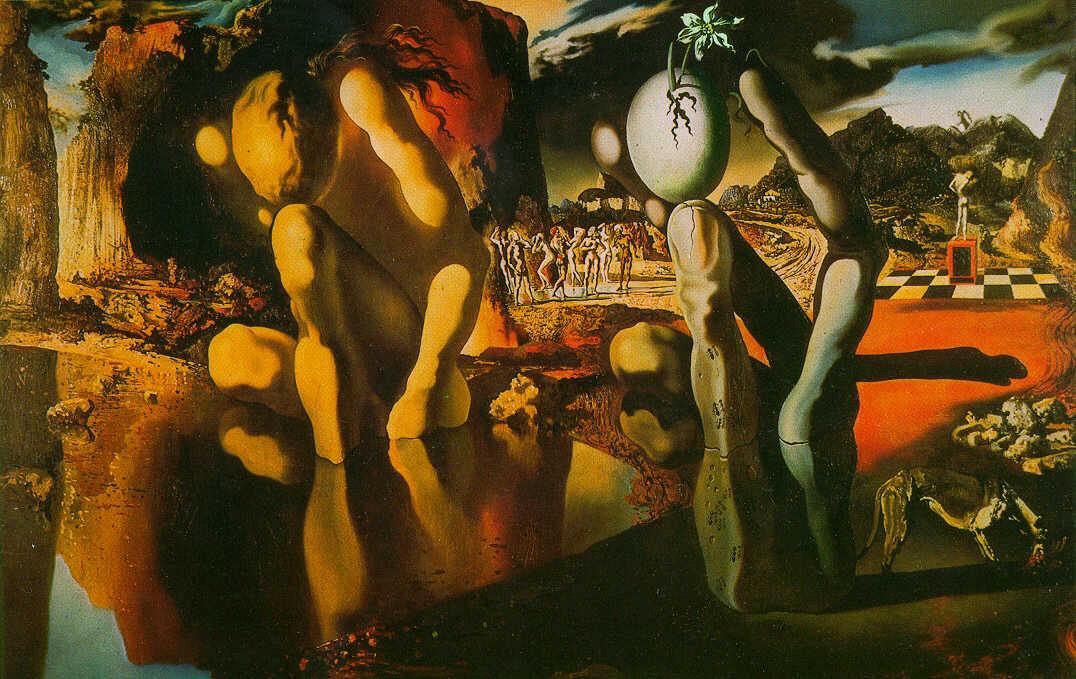
Salvador Dali is one of my favorite painters. He is known for his artistic style called surrealism.  Surrealism is defined as "Pure psychic automatism, by which one proposes to express, either verbally, in writing, or by any other manner, the real functioning of thought. Dictation of thought in the absence of all control exercised by reason, outside of all aesthetic and moral preoccupation. *
The first painting shown above is one of his great paintings called The Persistence of Memory. I like it because I think it shows how time melts and how memory fades. The second painting below is called The Metamorphosis of Narcissus, I like it too because I think it  represents a "change of perspective."  

I remember when I was a young boy, I have been doing paintings of these kinds. I was painting whatever it was that I saw in my mind, avoiding copying neither conscious pictures nor following the instructions of my art teachers. Back then, I did not know these styles of art were called Surrealism, but at that young age, I was pretty sure what kinds of paintings attracted me most; although, it is only now that I am getting to understand the workings of my mind.


*wiki

08 August 2010

The Death of Sociology

Chapter 1: Freshman


Last night I had a chance to have dinner with an accountant, a doctor, and a dentist. And while we were having our meal and having casual intercourse on what we do and how we are doing, the spotlight  suddenly turned to me and the doctor asked me a question:


"What was your course back in college?"


The dentist and the accountant was eager in anticipation of what I had to answer, too.


"Sociology." -- I told them.


Chapter 2: Sophomore


You should have seen the look on their faces. It is as if they have lost their marbles. It is as if what I said did not deserve any merit. As if they could not believe their ears.


Then the accountant blurted out, "What's that?"--  which I personally construed to mean, "What the fuck is that? That is the dumbest course I have ever heard."


I just smiled and slyly changed the topic.


I pointed out that how great the meal was. Then I talked about the importance of doctors to the society especially to the provinces and remote places and how the medical cases of indigent patients could have been curable if only given the proper standard of care as those who had money. I also told the dentist how I felt when I  recently had my root canal and impacted tooth extracted. Then I also admired what accountants do and the fact that I love math but suck at numbers.


The thing  is, sometimes, we do not have to explain ourselves. As the saying goes, the thing with explanations is that your friends do not need it, and strangers or enemies would not believe you anyway; although, at the back of my mind, there was already an outline on how I was going to answer the "what is sociology?" question.


Chapter 3: Junior


 I would have started by defining it:


"Sociology studies human social behavior, especially the study of the origins, organization, institutions, and development of human society; Sociology studies social institution or societal segment as a self-contained entity or in relation to society as a whole."


Then, I would have shared to them about what the "sociological imagination" means and why it is the first step in appreciating sociology:

"Coined by C. Wright Mills in 1950's, he argued that ‘nowadays men often feel that their private lives are a series of traps’ . Mills maintained that people are trapped because ‘their visions and their powers are limited to the close-up scenes of job, family [and] neighborhood’, and are not able to fully understand the greater sociological patterns related to their private troubles.

A lot of times people feel this kind of trap because they feel that they are so consumed with their personal lives. Life for them is a mere  trajectory, a mere routine, a mere series of personal events. They are convinced that this life in nothing  but a rat race, a personal struggle to be solved.

Yet, if you look at it in a different perspective, "Neither the life of an individual nor the history of a society can be understood without understanding both" (Mills, 1956)

This understanding is what Mills calls the Sociological Imagination: the 'quality of mind' which allows one to grasp "history and biography and the relations between the two within society"

Ordinary people do not possess the quality of mind essential to grasp the interplay of man and society, of biography and history, of self and world." It is only with this interconnectedness of society and the individual that we can truly understand and possibly solve societal or individual problems/issues."

After that, I would have probably introduced them to the fathers of modern Sociology - Max Weber, Karl Marx, and Emil Durkheim. I would have probably explained to them Durkheim's goal of providing a scientific basis for social order and for morality to replace religion, Marx's moral condemnation of the capitalist social order, and Weber's explanation of social authority.


I would have probably told them Sociology's emergence, development, and current state.


But I did not.


Chapter 4: Senior


I hate to admit this in front of my colleagues and classmates back in college who are very passionate about sociological theories in general and to my brilliant professors who have dedicated their lives in the study of sociology, but the truth is - sometimes I feel  like I might have taken the wrong course back in college.


I have not really applied Sociology or found any use applying its principles to make more money. Sure I can explain social phenomena, but it does not make me any different than Kuya Kim Atienza or Ka Earnie Baron who knows tons of trivia (trivia means non-important, insignificant facts).


While my other friends studied to became doctors, dentists, and nurses are now treating patients whose lives depends on hard scientific knowledge and skill; while my other friends who studied engineering and architecture are now building houses, roads, and bridges; while my other friends who studied to be accountants are now making money by counting money; while my friends who studied to be businessmen are now making money work for them -- I, on the other hand, am lost, and have found my course (sociology) inadequate to make a dent of change in our society or at least to make money by applying the discipline of my course. I feel like it will not get any better.


Worse, I have a weird hunch that most Sociology students like myself, have turned out to be unhappy, nosy, facetious, obnoxiously assertive impudent individuals who are now struggling to make money out of sociological theories and imaginations or are doing something completely different from sociology.


I sometimes toy on the idea that I should have taken TESDA training on how to be mortician. I should have just  studied the science of preserving dead bodies. I could have gotten my license and probably landed a job abroad where morticians are very rare and the pay they earn is around (2) two million Pesos a year.


Like cold lifeless bodies in morgues, I feel like Sociology has suffered the same fate. It is dead. Sociology is dead. At least for me, it is as useless as a brick.


I lament and feel sorry for the fanatics of the discipline. But today, I'll put it in a box and bury it six feet underground. I will move on with my life and try get over it. My radical enchantment with it has ended. It is as impotent as penile erectile dysfunction as other "soft" sciences and is probably going the line of alchemy and astrology.


Here is the deal, you can stay with it, stick with it, learn it, be fascinated with it, learn some more, read some more, write some more, but it will not really get you anywhere. In the final analysis, we have to find some other ways and means  to hunt for food and bring home the dough if the present tools that we have cannot deliver anymore.


Chapter 5: Graduation


It is not that I despise sociology, I love sociology. It hurts me to let it go.  It took me to places I never been and showed me a perspective of life few people ever discover. But as hard science and other indispensable disciplines have built power tools  to chop trees, I feel as if sociology remained a dull knife that, as far as I am concerned, I have found of very little use.


Ask me again, "what is sociology?" I will again just probably change the topic and keep my mouth shut. When it comes to the preserving of the memory of the dead, it is always prudent to just keep quiet, especially  if I do not have anything nice to say about it  for the moment.


04 August 2010

In Re: Mama's Birthday

July 20, 2010

Dear Mama,

Happy Birthday!
Thank you for bringing me to this world. Without you - I am nothing. Your parents must have been so proud when you were born! I share your happiness on this special day.

I do appreciate everything that you do for the family ma. What really makes you special is the fact that you are not only our mother mother, you are also our friend.

This world is a dangerous place ma - a  lot of things may go wrong, but thank the heavens for your tender love bestows a unique atmosphere  of peace, understanding, and console.

I am glad you liked the Banoffee Cake that we got for you. :)

Love,

Your son,

Always and forever,

Rah.


PS: Look ma, I found a picture of you!
Here's a picture of you on your  wedding day 27 years ago. You were just 22 then.
I love you ma, hope you get to  read this someday.

23 July 2010

The Death of Sociology

Chapter 1: Freshman

Last night I had a chance to have dinner with an accountant, a doctor, and a dentist. And while we were having our meal and having casual intercourse on what we do and how we are doing, the spotlight  suddenly turned to me and the doctor asked me a question:

"What was your course back in college?"

The dentist and the accountant was eager in anticipation of what I had to answer, too.

"Sociology." -- I told them.


Chapter 2: Sophomore

You should have seen the look on their faces. It is as if they have lost their marbles. It is as if what I said did not deserve any merit. As if they could not believe their ears.

Then the accountant blurted out, "What's that?"--  which I personally construed to mean, "What the fuck is that? That is the dumbest course I have ever heard."

I just smiled and slyly changed the topic.

I pointed out that how great the meal was. Then I talked about the importance of doctors to the society especially to the provinces and remote places and how the medical cases of indigent patients could have been curable if only given the proper standard of care as those who had money. I also told the dentist how I felt when I  recently had my root canal and impacted tooth extracted. Then I also admired what accountants do and the fact that I love math but suck at numbers.

The thing  is, sometimes, we do not have to explain ourselves. As the saying goes, the thing with explanations is that your friends do not need it, and strangers or enemies would not believe you anyway; although, at the back of my mind, there was already an outline on how I was going to answer the "what is sociology?" question.


Chapter 3: Junior

 I would have started by defining it:

"Sociology studies human social behavior, especially the study of the origins, organization, institutions, and development of human society; Sociology studies social institution or societal segment as a self-contained entity or in relation to society as a whole."

Then, I would have shared to them about what the "sociological imagination" means and why it is the first step in appreciating sociology:
"Coined by C. Wright Mills in 1950's, he argued that ‘nowadays men often feel that their private lives are a series of traps’ . Mills maintained that people are trapped because ‘their visions and their powers are limited to the close-up scenes of job, family [and] neighborhood’, and are not able to fully understand the greater sociological patterns related to their private troubles.
A lot of times people feel this kind of trap because they feel that they are so consumed with their personal lives. Life for them is a mere  trajectory, a mere routine, a mere series of personal events. They are convinced that this life in nothing  but a rat race, a personal struggle to be solved.
Yet, if you look at it in a different perspective, "Neither the life of an individual nor the history of a society can be understood without understanding both" (Mills, 1956)
This understanding is what Mills calls the Sociological Imagination: the 'quality of mind' which allows one to grasp "history and biography and the relations between the two within society"
Ordinary people do not possess the quality of mind essential to grasp the interplay of man and society, of biography and history, of self and world." It is only with this interconnectedness of society and the individual that we can truly understand and possibly solve societal or individual problems/issues."
After that, I would have probably introduced them to the fathers of modern Sociology - Max Weber, Karl Marx, and Emil Durkheim. I would have probably explained to them Durkheim's goal of providing a scientific basis for social order and for morality to replace religion, Marx's moral condemnation of the capitalist social order, and Weber's explanation of social authority.

I would have probably told them Sociology's emergence, development, and current state.

But I did not.


Chapter 4: Senior

I hate to admit this in front of my colleagues and classmates back in college who are very passionate about sociological theories in general and to my brilliant professors who have dedicated their lives in the study of sociology, but the truth is - sometimes I feel  like I might have taken the wrong course back in college.

I have not really applied Sociology or found any use applying its principles to make more money. Sure I can explain social phenomena, but it does not make me any different than Kuya Kim Atienza or Ka Earnie Baron who knows tons of trivia (trivia means non-important, insignificant facts).

While my other friends studied to became doctors, dentists, and nurses are now treating patients whose lives depends on hard scientific knowledge and skill; while my other friends who studied engineering and architecture are now building houses, roads, and bridges; while my other friends who studied to be accountants are now making money by counting money; while my friends who studied to be businessmen are now making money work for them -- I, on the other hand, am lost, and have found my course (sociology) inadequate to make a dent of change in our society or at least to make money by applying the discipline of my course. I feel like it will not get any better.

Worse, I have a weird hunch that most Sociology students like myself, have turned out to be unhappy, nosy, facetious, obnoxiously assertive impudent individuals who are now struggling to make money out of sociological theories and imaginations or are doing something completely different from sociology.

I sometimes toy on the idea that I should have taken TESDA training on how to be mortician. I should have just  studied the science of preserving dead bodies. I could have gotten my license and probably landed a job abroad where morticians are very rare and the pay they earn is around (2) two million Pesos a year.

Like cold lifeless bodies in morgues, I feel like Sociology has suffered the same fate. It is dead.Sociology is dead. At least for me, it is as useless as a brick.

I lament and feel sorry for the fanatics of the discipline. But today, I'll put it in a box and bury it six feet underground. I will move on with my life and try get over it. My radical enchantment with it has ended. It is as impotent as penile erectile dysfunction as other "soft" sciences and is probably going the line of alchemy and astrology.

Here is the deal, you can stay with it, stick with it, learn it, be fascinated with it, learn some more, read some more, write some more, but it will not really get you anywhere. In the final analysis, we have to find some other ways and means  to hunt for food and bring home the dough if the present tools that we have cannot deliver anymore.


Chapter 5: Graduation

It is not that I despise sociology, I love sociology. It hurts me to let it go.  It took me to places I never been and showed me a perspective of life few people ever discover. But as hard science and other indispensable disciplines have built power tools  to chop trees, I feel as if sociology remained a dull knife that, as far as I am concerned, I have found of very little use.

Ask me again, "what is sociology?" I will again just probably change the topic and keep my mouth shut. When it comes to the preserving of the memory of the dead, it is always prudent to just keep quiet, especially  if I do not have anything nice to say about it for the moment.

20 July 2010

The Death of Sociology


Chapter 1: Freshman

Last night I had a dinner with an accountant, a doctor, and a dentist. And while we were having our meal and having casual intercourse on what we do and how we are doing, the spotlight  suddenly turned to me and the doctor asked me a question:

"What was your course back in college?"

The dentist and the accountant were eager in anticipation of what I had to answer, too.

"Sociology." -- I told them.


Chapter 2: Sophomore

You should have seen the look on their faces. It is as if they have lost their marbles, as if they could not believe their ears.

Then the accountant blurted out, "What's that?"--  which I personally construed to mean, "What the f*ck is that? That is probably a dumb course."

I just smiled and slyly changed the topic.

I pointed out that how great the meal was. Then I talked about the importance of doctors to the society especially to the provinces and remote places and how the medical cases of indigent patients could have been curable if only given the proper standard of care as those who had money. I also told the dentist how I felt when I  recently had my root canal and impacted tooth extracted. Then I also admired what accountants do and the fact that I love math, but suck at numbers.

As the saying goes, the thing with explanations is that your friends do not need it, and strangers or enemies would not believe you anyway; although, at the back of my mind, there was already an outline on how to answer the "What is sociology?" question.


Chapter 3: Junior

 I would have started by defining it:

"Sociology studies human social behavior, especially the study of the origins, organization, institutions, and development of human society; Sociology studies social institution or societal segment as a self-contained entity or in relation to society as a whole."

Then, I would have shared to them about what the "sociological imagination" means and why it is the first step in appreciating sociology:
"Coined by C. Wright Mills in 1950's, he argued that ‘nowadays men often feel that their private lives are a series of traps’ . Mills maintained that people are trapped because ‘their visions and their powers are limited to the close-up scenes of job, family [and] neighborhood’, and are not able to fully understand the greater sociological patterns related to their private troubles.
A lot of times people feel this kind of trap because they feel that they are so consumed with their personal lives. Life for them is a mere  trajectory, a mere routine, a mere series of personal events. They are convinced that this life in nothing  but a rat race, a personal struggle to be solved.
Yet, if you look at it in a different perspective, "Neither the life of an individual nor the history of a society can be understood without understanding both" (Mills, 1956).
This understanding is what Mills calls the Sociological Imagination: the 'quality of mind' which allows one to grasp "history and biography and the relations between the two within society."
Ordinary people do not possess the quality of mind essential to grasp the interplay of man and society, of biography and history, of self and world." It is only with this interconnectedness of society and the individual that we can truly understand and possibly solve societal or individual problems/issues."
After that, I would have probably introduced them to the fathers of modern Sociology - Max Weber, Karl Marx, and Emil Durkheim. I would have probably explained to them Durkheim's goal of providing a scientific basis for social order and for morality to replace religion, Marx's moral condemnation of the capitalist social order, and Weber's explanation of social authority.

I would have probably told them Sociology's emergence, development, and current state.

But I did not.


Chapter 4: Senior

I hate to admit this in front of my colleagues and classmates back in college who are very passionate about sociological theories in general and to my brilliant professors who have dedicated their lives in the study of sociology, but the truth is - I sometimes  feel  like I might have taken the wrong course back in college.

I have not really applied Sociology or found any use applying its principles to make more money. Sure I can explain social phenomena, but it does not make me any different than Kuya Kim or Ka Earnie who know tons of interesting, nice-to-know facts.

While my other friends studied to became doctors, dentists, and nurses are now treating patients whose lives depends on hard scientific knowledge and skill; while my other friends who studied engineering and architecture are now building houses, roads, and bridges; while my other friends who studied to be accountants are now counting money; while my friends who studied to be businessmen are now minding their own business -- I, on the other hand, am lost, and have found my course (Sociology) inadequate to make a ding of change in our society or at the very least, make money by applying what I learned out of my course; and sometimes I feel like it will not get any better.

Worse, I have a weird hunch that most Sociology students like myself, have turned out to be unhappy, nosy, facetious, obnoxiously assertive impudent individuals who are now struggling to make money out of sociological theories and imaginations or are doing something completely different from sociology.

I sometimes toy on the idea that I should have taken TESDA training on how to be mortician. I should have just studied the science of preserving dead bodies. I could have gotten my license and probably landed a job abroad where morticians are very rare and the pay they earn is around two million pesos a year.

Like cold lifeless bodies in morgues, I feel like Sociology has suffered the same fate. It is dead. Sociology is dead. At least for me, it is as useless as a brick.

I feel sorry for the die hard fanatics of the discipline. But today, I've put it in a box and bury it six feet underground. I will move on with my life and try get over it. My radical enchantment with it has ended. It is as impotent as penile erectile dysfunction as other "soft" sciences -- and is probably going the line of alchemy and astrology.

Here is the deal, you can stay with it, stick with it, learn it, be fascinated with it, learn some more, read some more, write some more, but it will really get you anywhere? In the final analysis, we have to find some other ways to hunt for food.


Chapter 5: Graduation

I do not despise sociology, I love sociology. It hurts to let it go.  It took me to places I never been and showed me a perspective of life few people ever discover. But as hard science and other indispensable disciplines have built power tools  to chop trees, I feel like as if sociology remained a dull knife that, I have found of limited use. Is sociology still relevant? What is its relevance to me at this point in my life?

Times are changing, to be able to get the most of ourselves, I feel that we must not be afraid to set sail and go beyond our areas of discipline to find out what else is there that will make our lives more meaningful and fulfilling. "What is sociology?" I will just change the topic again.  Sometimes, when it comes to preserving the good memory of the dead, it's prudent to just not say anything.